Issue №4(12), 2024
Issue №4(12)
- Year 2024
- Pages 109
- Published 25 May. 2025
- Views 336
- PDF downloads 164
- Permanent link to the issue https://www.asvestnik.ru/en/issue/4-12-2024
Articles in This Issue
7 itemsNo section
History
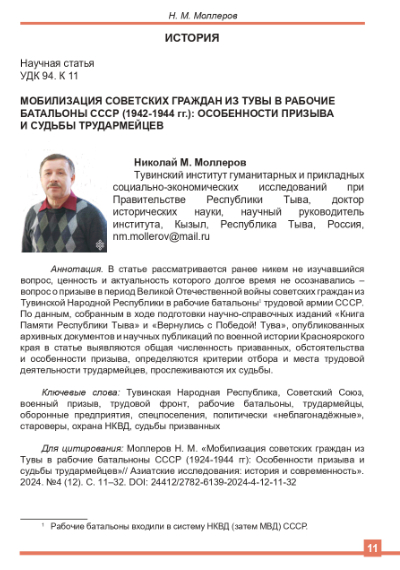
THE MOBILIZATION OF SOVIET CITIZENS FROM TUVA INTO THE WORKERS' BATTALIONS OF THE USSR (1924-1944): THE PECULIARITIES OF CONSCRIPTION AND THE FATE OF THE LABOR ARMY
The article examines a previously unexplored issue, the value and relevance of which has not been realized for a long time – the conscription of Soviet citizens from the Tuvan People's Republic to the workers' battalions of the USSR Labor Army during the Great Patriotic War. According to the data collected during the preparation of the scientific reference publications "The Book of Memory of the Republic of Tyva" and "We returned with a Victory! Tuva", published archival documents and scientific publications on the military history of the Krasnoyarsk Territory, the article reveals the total number of conscripts, the circumstances and features of conscription, the selection criteria and places of work of the labor army are determined, their fate is traced.
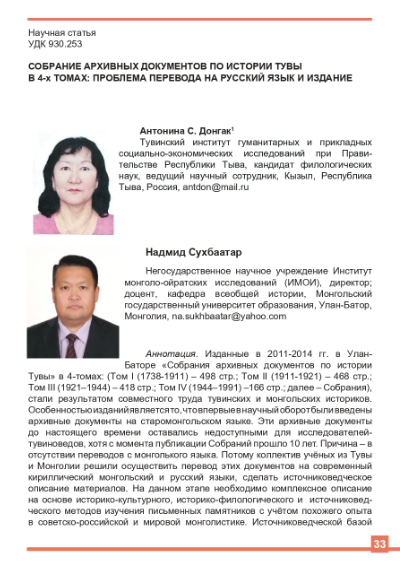
COLLECTION OF ARCHIVAL DOCUMENTS ON THE HISTORY OF TUVA IN 4 VOLUMES: THE PROBLEM OF TRANSLATION INTO RUSSIAN AND PUBLICATION
Antonina S-O. Dongak , Nadmid Sukhbaatar
“Collections of archival documents on the history of Tuva” in 4 volumes: (Volume I (1738-1911) - 498 pages; Volume II (1911-1921) - 468 pages; Volume III (1921-1944) - 418 pages; Volume IV (1944-1991) -166 pages; further – Collections), published in 2011-2014 in Ulaanbaatar, became the result of the joint work of Tuvan and Mongolian historians. The peculiarity of the publications is that for the first time the originals of archival documents in the Old Mongolian script were introduced into scientific circulation. At the same time, the difficulty lies in the fact that these archival documents in the Old Mongolian script as sources remain inaccessible to Tuvan researchers to this day, although 10 years have passed since the publication of the Collections. The reason is that the Sources have not been translated from the old Mongolian Language. Therefore, the team of scientists from Tuva and Mongolia sets the objectives to translate these documents into modern Cyrillic Mongolian and Russian, to make a source description of the sources. It is necessary a comprehensive description based on historical, cultural, historical, philological and source-based methods of studying written monuments, taking into account similar experiences in Soviet-Russian and world mongolistics. The publication of these documents in Russian will become additional sources when writing new works by Tuvinologists of different profiles.
MIGRATION PROCESSES AND THE ETHNIC STRUCTURE OF THE POPULATION OF TUVA IN THE 19TH – FIRST HALF OF THE 20TH CENTURIES.
The article examines migration processes and their impact on ethnic and socio-demographic characteristics of the population in the 19th and the first half of the 20th centuries. The socio-economic and political factors that contributed to the migration of the population during this period have been identified.
Economics
THE DEVELOPMENT OF THE REPUBLIC OF TUVA IN THE RUSSIAN ECONOMIC SPACE: THE PAST, THE PRESENT, AND THE FUTURE
Vyacheslav E. Seliverstov , Aydys P. Temir-ool
The authors discussed the main results of the past period of development of Tuva in the economic space of Russia and the main problems of the present stage. It is concluded that these problems are largely determined by the imperfection of the Russian national regional, structural and investment policy and the lack of necessary tools and mechanisms to overcome the depressiveness and backwardness of a number of Russian subsidized regions. It is shown that in addition to the implementation of a set of measures of economic and social policy to adapt the region to the new economic and geopolitical situation. There is necessity of a gradual transition to a new model of development of the Republic of Tuva within the framework of the new model of Siberia’s development. The authors revealed most important directions of the prospective development of Tuva are considered, which should be implemented in the unity of interrelated actions of the authorities, business and society, the federal center and the republic itself (development of new types of natural resources on new principles of subsoil use; participation of Tuva in increasing the connectivity of the space of Asian Russia; strengthening the inclusion of the republic in the new system of cross-border interactions; implementation of a new environmental policy with a focus on strengthening the Republic’s positioning as a Russian region with unique biodiversity; modernization of the agrarian complex; integration into new technological trends). The republics needs in strong scientific support of the program of modernization of economy, social sphere and ecology of Tuva by consolidation of efforts of all republican forces with attraction of external partners - academic institutes, universities, consulting companies (Russian and international).
TOURISM POTENTIAL OF TUVA IN THE CONTEXT OF THE DEVELOPMENT OF INTERNAL TOURISM IN SIBERIA
Internal tourism in modern conditions is a priority direction for the development of regional economies in the medium term in many Russian regions. Assessing and increasing the tourism potential of territories is an important task both in a practical sense and an urgent scientific problem. The article provides data on the development of internal tourism in Siberia. Siberia, as a vast region of Russia, is becoming increasingly attractive to Russian and foreign tourists. In addition to traditional, popular places to visit among tourists, such as Baikal, Altai, Sayan Mountains there are new interesting locations for a wide range of travelers. These include the Tyumen region with its geothermal springs, the city of Tobolsk - the ancient Siberian capital; Khakassia with Lake Shira and interesting archaeological sites; Kemerovo region, with the Sheregesh ski resort and Tomsk pisanitsa; Tuva with its unique mountain landscapes and archaeological sites. The author emphasized the role and importance of the hospitality industry in the development of regional economies of the constituent entities of the eastern regions of the country, including the territories of the constituent entities of the Federation of the Ural and Siberian Federal Districts.There are features and tourism potential of the Republic of Tuva in the article. The author has made to determine the modern vector of development of the tourism industry in the Republic of Tuva. The Republic has a unique natural, cultural and historical heritage, sites included in the list of world natural heritage monuments and under the patronage of UNESCO (for example, the Ubsunur Basin since 2003). In this regard, Tuva has significant prospects for the development and use of its tourism potential.
Personalities
THE SCIENTIFIC HERITAGE OF MONGUSH SENDAZHIEVICH BAYIR-OOL (ON THE 85TH ANNIVERSARY OF THE RESEARCHER)
The article is an analytical review of the scientific works of the famous Tuvan researcher, Candidate of Philosophical Sciences, Honored Worker of the Republic of Tuva, a historian, ethnosociologist and ethnopolitologist Mongush Sendazhievich Bayyr-ool (1939-2021), dedicated to his 85th anniversary. The purpose of the article is to study the main scientific works of Mongush Bayir-ool on the basis of a bio-bibliographic index compiled with his own participation in 2019. The author provides a brief biographical information about him, as well as highlights the main topics of his research: ethnography of Tuvan nomads, ethnopolitology and political history of Tuva, biographies of Tuvan politicians and the chronicle of political repression in Tuva. The author highlights the biography of Salchak Toka (1901-1973), since Mongush Bayir-ool had a particular interest in this debatable guestion. His works acquire additional historiographical and source-based value. In general Mongush Bayir-ool’s scientific heritage represents a unique and rich reservoir of materials for historians, ethnographers, sociologists and political scientists studying the history of Tuva in accordance with the main themes of his scientific works.