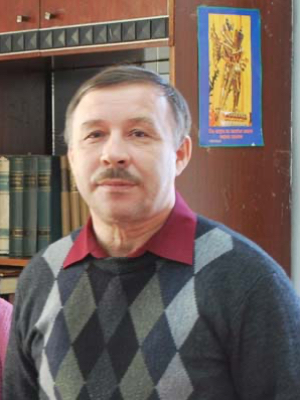
Nikolay M. Mollerov
Publications by the Author
11 publications
THE MOBILIZATION OF SOVIET CITIZENS FROM TUVA INTO THE WORKERS' BATTALIONS OF THE USSR (1924-1944): THE PECULIARITIES OF CONSCRIPTION AND THE FATE OF THE LABOR ARMY
The article examines a previously unexplored issue, the value and relevance of which has not been realized for a long time – the conscription of Soviet citizens from the Tuvan People's Republic to the workers' battalions of the USSR Labor Army during the Great Patriotic War. According to the data collected during the preparation of the scientific reference publications "The Book of Memory of the Republic of Tyva" and "We returned with a Victory! Tuva", published archival documents and scientific publications on the military history of the Krasnoyarsk Territory, the article reveals the total number of conscripts, the circumstances and features of conscription, the selection criteria and places of work of the labor army are determined, their fate is traced.
THE VOLUNTARINESS, LEGALITY AND TIMELINESS OF THE ENTRY OF THE TUVAN PEOPLE’S REPUBLIC TO THE USSR AND THE RSFSR (ON THE 80TH ANNIVERSARY OF THE HISTORICAL EVENT)
In the article dedicated to the 80th anniversary of Tuva's voluntary entry into the USSR and the RSFSR in October 1944, the author's attention is focused on revealing three main aspects of this truly fateful event for Tuva - its voluntariness, legality and timeliness. It also notes the speculative approach of liberal authors to covering these issues without strong reliance on sources. The author notes the lack of study by the predecessors of a number of important aspects and details of the problem, and a more indepth study was undertaken, including with the involvement of new sources (periodicals and archival documents). The conclusions of the Russian authors on the voluntariness, legality and timeliness of Tuva's entry into the Soviet Union and Russia were confirmed and strengthened in the article.
-
-
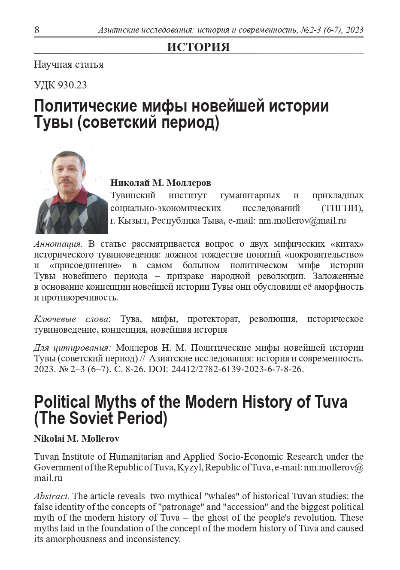
POLITICAL MYTHS OF THE MODERN HISTORY OF TUVA (THE SOVIET PERIOD)
The article reveals two mythical "whales" of historical Tuvan studies: the false identity of the concepts of "patronage" and "accession" and the biggest political myth of the modern history of Tuva - the ghost of the people's revolution. These myths laid in the foundation of the concept of the modern history of Tuva and caused its amorphousness and inconsistency.
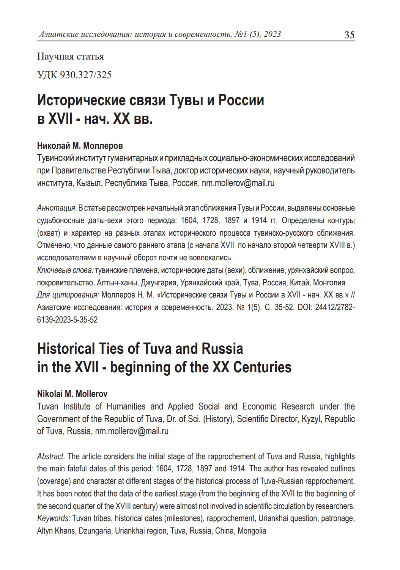
HISTORICAL TIES OF TUVA AND RUSSIA IN THE XVII - BEGINNING OF THE XX CENTURIES
The article considers the initial stage of the rapprochement of Tuva and Russia, highlights the main fateful dates of this period: 1604, 1728, 1897 and 1914. The author has revealed outlines (coverage) and character at different stages of the historical process of Tuva-Russian rapprochement. It has been noted that the data of the earliest stage (from the beginning of the XVII to the beginning of the second quarter of the XVIII century) were almost not involved in scientific circulation by researchers.
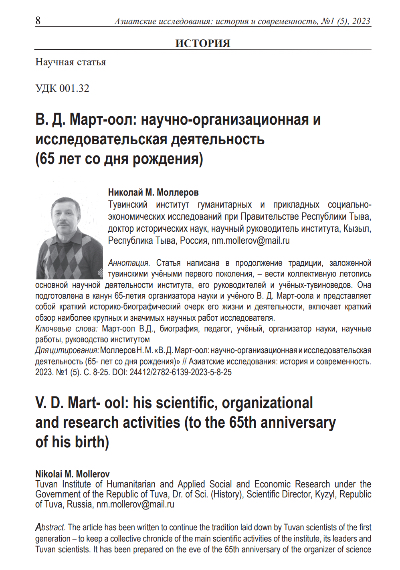
V. D. MART- OOL: HIS SCIENTIFIC, ORGANIZATIONAL AND RESEARCH ACTIVITIES (TO THE 65TH ANNIVERSARY OF HIS BIRTH)
The article has been written to continue the tradition laid down by Tuvan scientists of the first generation - to keep a collective chronicle of the main scientific activities of the institute, its leaders and Tuvan scientists. It has been prepared on the eve of the 65th anniversary of the organizer of science and scientist V. D. Mart-ool and presents a brief historical and biographical sketch of his life and work, including a brief overview of the largest and most significant scientific works of the researcher.
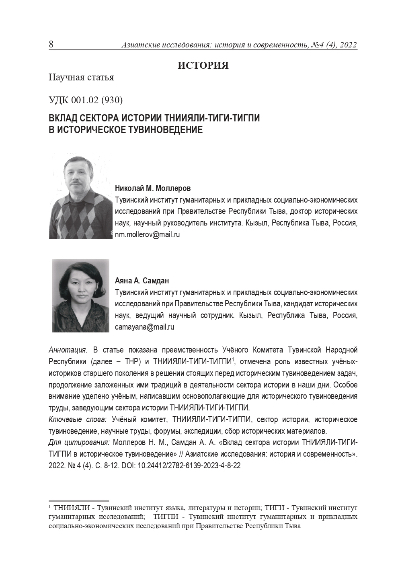
CONTRIBUTION OF HISTORY SECTOR OF TNIIYALI-TIGI-TIGPI TO HISTORICAL TUVINIAN STUDIES
The article reveales the continuity of the Scientific Committee of the Tuvan People's Republic (hereinafter – TNR) and the TNIIYALI-TIGI-TIGPI, the role of famous historians of the older generation in solving the tasks facing historical Tuvan studies, the continuation of their traditions in the activities of the history sector in our days. A special attention has been paid to the scientists who wrote the fundamental works for historical Tuvinian studies, as well as to the head of the history sector of TNIIYALI-TIGI-TIGPI.
-2022--8-24_4RXqe.jpg)
THE DISTRICT BUREAU OF THE RUSSIAN COMMUNIST PARTY (OF BOLSHEVIKS)-THE ALL-UNION COMMUNIST PARTY (OF BOLSHEVIKS) IN (1921-1944)
The article reveals the role and activities of the regional party bureau of the RCP (b), which was the political head of the Soviet foreign colony in the Tuva People’s Republic and organizationally united all communists – from the RSTK and Committees of Soviet Citizens to Soviet diplomatic workers, advisers, instructors and specialists.
THE SOVIET FACTOR IN THE SPATIAL AND ECONOMIC DEVELOPMENT OF THE TPR
The author taking into account the relevance of the problem of a qualitatively new organization of the regional socio-economic space of Russia and its regions, has made an attempt to determine possible priority actions in accordance with new requirements for the organization of spatial development. The author considers that it is important to pay attention to traditional features and needs of the population of modern Tuva.
THE KHEMCHIK MUTINY OF 1924: CAUSES AND COURSE OF THE UPRISING
The article presents the results of the analysis of the external and internal political situationin in the Tuvan People's Republic, undertaken to reveal the causes of the armed uprising in Khemchik in 1924. It also examines the course of the uprising and its peaceful settlement at the trilateral Tuvan-Mongol-Soviet conference. The author has used both scientific research and the new archival data in the analysis and recovering the course of events.
TRANSFORMATIONS AND INNOVATIONS OF PUBLIC ADMINISTRATION, TAX, AND CREDIT-FINANCIAL SYSTEMS IN THE TPR
The article reveals the content of historical processes at the “non-capitalist” stage of modernization (the period of the Tuvan People's Republic - the TPR) in the aspect of transformations and innovations in vitally important areas of the functioning of the TPR: public administration, tax, and credit-financial systems.